SONYA LUCAS
Under Ordinary Light
Exhibition May 2-30 at Stone Village
This body of work is rooted in survival.
Painting has been the one consistent language I’ve had to metabolize the world—to regulate, to understand, to stay. Every mark is a continuation of that lifelong process, and this exhibition exists because of the people who have made space for me to keep going. My chosen family, my friends, the ones who show up, who see me, who celebrate this work as it is—you are part of this. I don’t make in isolation. I make because I’ve been held.
These paintings sit inside a moment that feels unstable—politically, socially, technologically. We are living in what often feels like a collapsing democracy, inside a culture increasingly seduced by artificiality, speed, and disembodiment. In that context, painting becomes something stubborn and necessary. A refusal, maybe.
The brushstroke matters. The human mark matters.
I intentionally leave the evidence of the hand visible—gestural, imperfect, unresolved—because those marks connect us backward as much as forward. They echo cave paintings, those early attempts not just to depict, but to orient. To make sense of fear. To locate oneself inside chaos. To find the hunt. To survive it.
This work is expressionist not just in style, but in function. It is processing. It is grief. It is an ongoing negotiation with belonging—where it exists, where it fractures, and how we attempt to rebuild it anyway.
The Repair
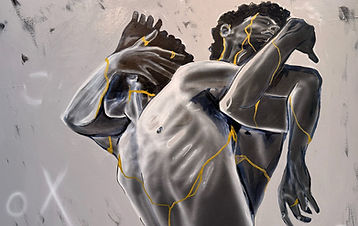
At first glance, two figures appear locked in conflict. But they are not separate. They are the same person—split along an internal fault line. One side coded more masculine, more rigid, more defended. The other, something softer but equally strained. The reference to kintsugi runs through the piece—not as decoration, but as a proposition. That repair is visible. That fracture is part of the form. It’s a painting about the disorientation of being at odds with yourself, and the slow, uneven work of stitching that divide back together. Of Healing.
Omnia Ardent
A house burns in a snow-covered field. A figure stands in the foreground, but their direction is unclear—approaching or leaving. The ambiguity is intentional. This piece sits in the psychological space of horizoning—that suspended state where forward movement feels impossible, where the future won’t fully form. Collectively, there’s a sense of standing in front of something that is already on fire and not knowing whether we are meant to save it, mourn it, or walk away. The house is personal, but it’s also not. It holds a larger anxiety about where we are and what is coming.

This Land
A series of American flags attempt to hold a gray void, arms extending, straining, dissolving into the surface. The ground itself feels worn—grungy, almost skin-like. There’s no clean separation between body, symbol, and landscape. Everything is entangled, eroding, trying to hold shape. It’s about ownership, identity, and the illusion of stability. About what it means to claim something that is already fragmenting—and what it costs to keep pretending it isn’t

Boy with Ladybug
A small, quiet moment—easy to pass by. A boy crouched with a ladybug, suspended between tenderness and harm. It’s unclear whether he’s about to care for it or crush it, and that uncertainty is the point. The painting holds that thin line where innocence and violence coexist without announcing themselves.

Under Ordinary Light
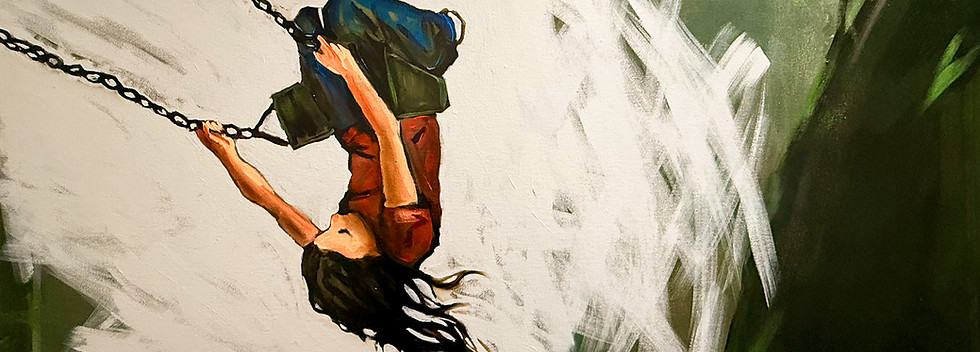
The title piece. A girl at the peak of a swing, the viewer positioned beneath her—held in that suspended moment between ascent and gravity. The lines are bold, defiant, feral, but her grip on the chains tells another story. She is on the edge of becoming. This painting isn’t interested in spectacle or purity—it’s about honoring that earlier self without flattening her into innocence. There’s joy here, yes, but also the weight of what she will carry. It’s a quiet act of witnessing an inner child—

Weight of Waiting
A gray field. A rib cage transitioning into white feathers. It lives in that space between endings and transformation. There is death here, but it is not static. The body is in the process of becoming something else—lighter, stranger, less fixed. It’s about the heaviness of waiting for change, and the strange hope embedded in that threshold. Not resolution—transformation.

Liam
Rendered like a single frame pulled from a comic book—the visual language I relied on as a child to survive, to escape, to imagine power where there was none. This piece responds to the abduction of 5-year-old Liam Conejo Ramos, which shook me deeply. Here, I rewrite the narrative. Liam becomes something else—someone with agency. He takes on the presence of Magneto, a figure who bends force fields, who resists authoritarian control. In this version, he is not powerless. He is pushing back. It’s not about denial—it’s about the need, sometimes, to create an alternate outcome just to keep breathing.

Be the Bear
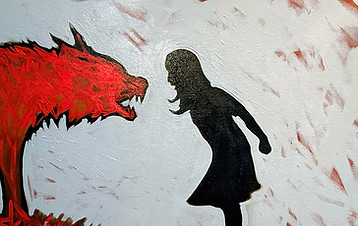
Rendered in silhouette as an homage to Kara Walker, a girl stands mid-scream, confronting a werewolf-like predator. The mark-making echoes Under Ordinary Light—but where that piece holds suspension, this one ruptures.
This is rage, and it’s not misplaced. It’s a response to the ongoing reality of violence against women—both historic and current—shaped by the cultural moment we’re living in. The title flips the familiar script: instead of shrinking, instead of choosing safety through silence, it insists on confrontation. On becoming something that cannot be easily consumed.
This exhibition is not offering answers. It’s offering evidence—of feeling, of fracture, of persistence. Of a human hand still reaching, still marking, still trying to find direction in the dark.